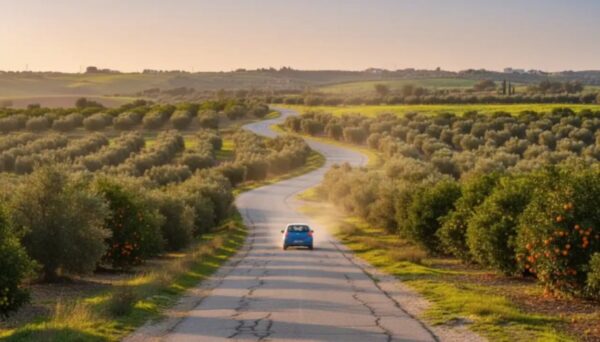
Tunisia may be small on the map, but it packs an incredible variety of landscapes within easy driving distance — Mediterranean beaches, Roman ruins, holy cities, and Saharan dunes are all just hours apart. That makes it one of the best countries in North Africa for a self-drive adventure. Here are three routes to consider, depending on how much time you have and what kind of trip you’re after.
Route 1: The Coastal Classic — Tunis → Sousse → Djerba This is the most popular self-drive route in the country, and for good reason. Starting in Tunis, the A1 motorway takes you south along the coast through Hammamet and Sousse before continuing all the way to Djerba — roughly 500 km in total, with a driving time of around 6 to 6.5 hours if done in one stretch. Most travelers break it into stops: Sousse’s UNESCO-listed medina, the Roman amphitheater at El Jem (a worthwhile detour), and Mahdia’s quiet beaches all sit along or near this route. The road itself is excellent — the A1 is a modern, well-maintained toll motorway for most of the journey. This route works well over 5 to 7 days, giving you time to enjoy the coast rather than just pass through it.
Route 2: The Heritage & Desert Route — Tunis → Kairouan → Tozeur For travelers who want history and desert scenery in one trip, this inland route is hard to beat. From Tunis, it’s about 155 km (roughly 2 hours) to Kairouan, the fourth holiest city in Islam and home to the Great Mosque and its striking Aghlabid basins. From there, continue southwest toward Tozeur — around 290 to 300 km, about 3.5 hours via Gafsa. Along the way, the landscape shifts dramatically, from olive groves to semi-arid steppe to the palm groves of the Jerid region. Tozeur is your gateway to the mountain oases of Tamerza, Chebika, and Mides, as well as the otherworldly Chott el Jerid salt lake. Roads on this route are paved and generally in good condition, though they’re quieter and services are more spread out — worth keeping in mind for fuel planning.
Route 3: The Grand Tour — Combining Both If you have 7 to 10 days, you can link the two routes into one longer loop: Tunis → Kairouan → Tozeur → Douz → Matmata → Djerba, finishing on the coast. This lets you experience the full range of what Tunisia offers — sacred cities, desert oases, Berber troglodyte villages, and Mediterranean beaches — before flying out from Djerba-Zarzis or looping back north. Total distance runs around 1,100–1,200 km, so this is best suited to travelers who enjoy the journey as much as the destinations.
What kind of car do you need? The right vehicle really depends on your route. For the coastal route between Tunis, Sousse, and Djerba, a compact car or sedan is perfectly comfortable — the roads are smooth motorway for most of the way. If your route heads inland toward Tozeur, Douz, or Matmata, an SUV is a smarter choice: it handles the longer stretches more comfortably and gives you more confidence on the occasional rougher rural road near the desert fringes. Keep in mind that driving off-road onto the salt flats or sand dunes themselves isn’t recommended with a standard rental — that’s best left to a guided 4×4 excursion.
Fuel, tolls, and parking notes Fuel stations are frequent in the north and along the coast, but become noticeably sparser once you head south of Gafsa or Tozeur — it’s wise to fill up before continuing toward Douz or deeper desert routes. Tunisia’s main motorways (A1, A3, A4) are tolled, with fees paid in cash at booths along the way, so keep small dinar notes handy. Parking in city centers like Tunis, Sousse, or Sfax is easiest in designated lots rather than street parking, especially near medinas where space is tight.
Whichever route you choose, having the right vehicle makes all the difference — a nimble city car for the coast, or a capable SUV if the desert is calling. Check out our Our Vehicles page to find the right fit for your itinerary before you hit the road.